آشنایی با ابر سازه sea launch
|
ایده ی اصلی: در سال 1962 سازمان فضایی ناسا و مرکز تحقیقات هوافضای دانشگاه رم ایتالیا برای ساختن ایستگاه فضایی شناوری در اقیانوس هند به توافق رسیدند. برای این منظور در ایتالیا دو سکوی شناور برای این پروژه ساختند. یکی از این سکو ها برای پرتاب موشک و دیگری برای مرکز کنترل در نظر گرفته شدند. آغاز پروژه ی Sea Launch پروژه ی Sea Launch یک همکاری بین المللی است. در این پروژه شرکت امریکاییBoeing کمپانی های روسی Energiya و Rubin همچنین شرکت کشتی سازی نروژی Kvaerner و دو شرکت هوافضای اوکراینی به نام Yuzhnoyeh و Yuzhmashzavod شرکت دارند. پایگاه این پروژه در Long Beach کالیفرنیا قرار دارد. نام سکوی به کار گرفته شده در این پروژه ادیسی است. در ابتدا از سکوی یاد شده برای استخراج نفت استفاده می شد. اما شرکت کشتی سازی نروژی Kvaerner سکوی ادیسی را برای به کار گیری در پروژه های فضایی آماده کرد. برای پرتاب ماهواره در پروژه ی Sea Launch راکت حمل کننده ی Zenit-3S به کار گرفته می شود. این راکت همچنین دارای بلوک افزایش دهنده و محموله ی قابل حمل است. این راکت توانایی حمل بار تا 6 تن را دارد. جرم ابتدایی راکت 444 تن و طول آن 43 متر است. در این پروژه شرکت بویینگ قسمت حمل بار راکت را طراحی و ساخت. هنگامی که راکت به فضا پرتاب می شود با به بکارگیری از بلوک افزایش دهنده ی خود شتاب کمکی می گیرد. در این هنگام قسمت بار از راکت جدا می شود و کمی بعد ماهواره از قسمت بار جدا می شود و به سمت مدار در نظر گرفته شده می رود. این پروژه در سفارش های زیادی را از شرکت های هوا فضایی و مخابراتی برای پرتاب ماهواره های ارتباطاتی دریافت کرده است. مزیت اصلی پروژه ی Sea Launch در این است که ماهواره ها آسان تر در مدار Geostationary قرار می گیرند. مدار Geostationary مداری است که بالای خط استوا قرار دارد ( صفر درجه ی عرض جغرافیایی) و وقتی ماهواره در این مدار قرار می گیرد از دید ناظر زمینی یک جسم بدون حرکت به نظر می رسد.
از مجله ی مکانیک عمومی |
| منبع :ParsSky.com |
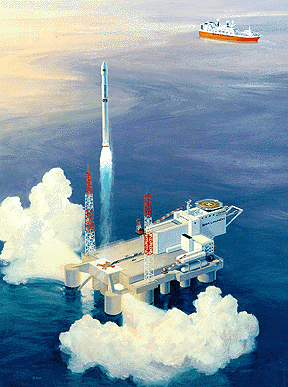 در سال 1966سکوی سنتا ریتا از ایتالیا فرستاده شد و از این سکو برای پرتاب اولین ماهواره ی تحقیقاتی ایتالیا به نام San Marco-B استفاده شد. این ماهواره برای تعیین تراکم لایه های بالایی اتمسفر به مدار پرتاب شد. با به کار گرفتن از سکوی جدید سن مارکو این پروژه شکل واقعی تر به خود پیدا کرد. از سکوی سن مارکو برای پرتاب بسیاری از ماهواره های تحقیقاتی استفاده شد. تلسکوپ فضایی Uhuru در 12 دسامبر 1970 نیز ازطریق این سکو به مدار پرتاب شد. یکی از مشکلاتی که این پروژه ظرفیت حمل بار کم آن بود.بیشینه ی حمل بار در این پروژه 200 کیلوگرم بود. موشک های حمل کننده ایی که در این پروژه به کار قرار می گرفتند از نوع Scout امریکایی بودند. به این ترتیب آخرین پرتاب از سکوی سن مارکو در 25 مارس سال 1988 صورت گرفت و این پروژه به دلیل مشکل یاد شده متوقف شد.
 بازگردان: صبا اکبری
Sea Launch

Sea Launch is a spacecraft launch service that uses a mobile sea platform for equatorial launches of commercial payloads on specialized Zenit 3SL rockets. It has assembled and launched thirty-one rockets, with two failures and one partial failure.
The sea-based launch system means the rockets can be fired from the optimum position on Earth's surface, considerably increasing payload capacity and reducing launch costs[1] compared to land-based systems.
Sea Launch was established in 1995 as a consortium of four companies from Norway, Russia, Ukraine and the United States, managed by Boeing with participation from the other shareholders.[2][3] The first rocket was launched in March 1999.
All commercial payloads have been communications satellites intended for geostationary transfer orbit with such customers as EchoStar, DirecTV, XM Satellite Radio, and PanAmSat.
The launcher and its payload are assembled on a purpose-built ship Sea Launch Commander in Long Beach, California, USA. It is then positioned on top of the self-propelled platform Ocean Odyssey and moved to the equatorial Pacific Ocean for launch, with the Sea Launch Commander serving as command center.
In June 2009 the provider of the Sea Launch service, Sea Launch Co. LLC, filed for Chapter 11 bankruptcy protection.[4] Sea Launch emerged from bankruptcy effective October 27, 2010.[5] Energia Overseas Limited, a Russian corporation, is majority owner of the reorganized entity.
Contents[hide] |
[edit] Ownership and business
Four companies from four countries shared the original ownership of Cayman Islands-registered Sea Launch.[6] It has been sold to Russian interests in October 2010 after going through Chapter 11 regulations. [7]
| Company | Country of origin | Ownership share | Contribution |
|---|---|---|---|
| Boeing Commercial Space | United States | 40% | System integration, payload enclosures (nose-cone that protects the satellite during launch) |
| Energia | Russia | 25% | Block DM-SL rocket stage (it is used in the Zenit 3SL rocket as its 3rd stage) |
| Aker Solutions | Norway | 20% | Launch platform (Ocean Odyssey) and command ship (Sea Launch Commander) |
| SDO Yuzhnoye / PO Yuzhmash | Ukraine | 15% | Two-stage Zenit rocket (used as Zenit 3SL's stages 1 and 2) |
The project was helped by Hughes Space and Communications, which in 1995 signed the first contract for 10 launches and 10 options, valued at $1bn, and Space Systems/Loral, which then signed a five-launch contract.
Total cost of the project has been reported at $583m in 1996. Chase Manhattan arranged about $400m in loans in 1996. Loans were later guaranteed against political instability in Russia and Ukraine through 2012 by the World Bank (up to $175m, of these up to $100m in Russia and up to $75m in Ukraine) and the European Bank for Reconstruction and Development (up to $65m).[3]
Sea Launch has a reciprocal agreement with Arianespace and Mitsubishi Heavy Industries through the Launch Services Alliance, providing assurance in case either company's system is not able to launch a payload for reasons of reliability, capacity, backlog, or otherwise. This was used for the first time in 2004 when Arianespace’s Ariane 5 had to reschedule a group of launches for reliability reasons.
The Sea Launch consortium claims that their launch-related operating costs are lower than a land-based equivalent due in part to reduced staff requirements. The platform and command ship have 310 crew members.[8]
On March 17, 2006 it was announced that Jim Maser, the President and General Manager of Sea Launch, would leave the company to join SpaceX as President and Chief Operating Officer.[9]
On June 22, 2009, the company filed for Chapter 11 protection.[10] Sea Launch asserts it will "continue to maintain all normal business operations after the filing for reorganization."[11]
On August 6, 2010, Energia, which already owned 25% of Sea Launch, announced it planned to acquire a controlling interest of 85 % in the company. As a result, the company plans to begin land-based launches from the Baikonur Cosmodrome in early 2011, while sea-based launches resumed in September 2011.[12]
[edit] Launches

The first demonstration satellite was launched on March 27, 1999 and the first commercial satellite on October 9, 1999. Sea Launch has launched 29 rockets with 26 successes and 1 partial success as of September 2008. The first failure, of a Hughes-built communications satellite owned by ICO Global Communications, occurred on the second commercial launch on March 12, 2000 and was blamed on a software error that failed to close a valve in the second stage of the rocket.
A second rocket failed to launch on January 30, 2007, when Zenit-3SL exploded on the launch pad with the Boeing 702 NSS-8 satellite on board, seconds after engine ignition.
All Sea Launch missions to date have used the custom-designed three-stage Zenit-3SL launch vehicle, capable of placing up to six tonnes of payload in geosynchronous orbit. Sea Launch rocket components are manufactured by SDO Yuzhnoye / PO Yuzhmash in Dnipropetrovsk, Ukraine (Zenit rocket for the first and second stages); by Energia in Moscow, Russia (Block DM-SL for third stage); and by Boeing in Seattle, United States (payload fairing and interstage structure).
Sea Launch rockets are assembled in Long Beach, California. The typical assembly is done onboard the Assembly and Command Ship (the payload is first tested, fueled and encapsulated in the nearby Payload Processing Facility). The rocket is then transferred to a horizontal hangar on the self-propelled launch platform.
Following rocket tests, both ships then sail about 4,828 km to the equator at 154° West Longitude,
 WikiMiniAtlas
With the platform ballasted to its launch depth of 22 m, the hangar is opened, the rocket is mechanically moved to a vertical position, and the launch platform crew evacuates to the command ship which moves about five kilometers away. Then, with the launch platform unmanned, the rocket is fueled and launched. The final ten seconds before launch are called out simultaneously in English and Russian.
| Date | Payload | Mass | Result | Number |
|---|---|---|---|---|
| March 27, 1999 | DemoSat | 4.5 t | success | 1 |
| October 9, 1999 | DIRECTV 1-R | 3.5 t | success | 2 |
| March 12, 2000 | ICO F-1 | 2.7 t | failure | 3 |
| July 28, 2000 | PAS-9 | 3.7 t | success | 4 |
| October 20, 2000 | Thuraya-1 | 5.1 t | success | 5 |
| March 18, 2001 | XM-2 ROCK | 4.7 t | success | 6 |
| May 8, 2001 | XM-1 ROLL | 4.7 t | success | 7 |
| June 15, 2002 | Galaxy IIIC | 4.9 t | success | 8 |
| June 10, 2003 | Thuraya-2 | 5.2 t | success | 9 |
| August 7, 2003 | EchoStar IX/Telstar 13 | 4.7 t | success | 10 |
| September 30, 2003 | Galaxy XIII/Horizons-1 | 4.1 t | success | 11 |
| January 10, 2004 | Telstar 14/Estrela do Sul 1 | 4.7 t | success | 12 |
| May 4, 2004 | DIRECTV-7S | 5.5 t | success | 13 |
| June 28, 2004 | Telstar-18 | 4.8 t | launch anomaly | 14 |
| March 1, 2005 | XM-3 | 4.7 t | success | 15 |
| April 26, 2005 | SPACEWAY-1 | 6.0 t | success | 16 |
| June 23, 2005 | Intelsat IA-8 | 5.5 t | success | 17 |
| November 8, 2005 | Inmarsat 4-F2 | 6.0 t | success | 18 |
| February 15, 2006 | EchoStar X | 4.3 t | success | 19 |
| April 12, 2006 | JCSAT-9 | 4.4 t | success | 20 |
| June 18, 2006 | Galaxy 16 | 5.1 t | success | 21 |
| August 22, 2006 | Koreasat 5 | 4.9 t | success | 22 |
| October 30, 2006 | XM-4 | 4.7 t | success | 23 |
| January 30, 2007 | NSS-8 | 5.9 t | failure | 24 |
| January 15, 2008 | Thuraya-3 | 5.2 t | success | 25 |
| March 19, 2008 | DirecTV-11 | 5.9 t | success | 26 |
| May 21, 2008 | Galaxy 18 | 4.6 t | success | 27 |
| July 16, 2008 | EchoStar XI | 5.5 t | success[13] | 28 |
| September 24, 2008 | Galaxy 19 | 4.7 t | success[14] | 29 |
| April 20, 2009 | SICRAL 1B | 3.0 t | success[15] | 30 |
| September 24, 2011 | Atlantic Bird 7 | 4.6 t | success | 31 |
[edit] NSS-8 launch failure

On January 30, 2007, the Sea Launch Zenit-3SL rocket carrying NSS-8 and 500 tons of fuel[16] exploded on launch.[17] Available imagery, which includes a video of the accident on YouTube, shows a fireball much larger than the launch platform at sea level.[18]
Since the launch pad platform is vacated by all engineers during the automated launch process, there were no injuries. On February 1, 2007 Sea Launch released a statement detailing its status.[19]
It is believed that the failure was caused by a foreign object being ingested by the engine, causing the rocket to crash immediately.[20]
On February 3, 2007, photographs of the damage were posted on internet forums.[21] The launch platform damage is mostly superficial, though blast deflectors underneath the launch platform were knocked loose and were lost when they fell into the sea.
In March 2007, shortly after the NSS-8 launch failure, Hughes Network Systems switched the launch of SPACEWAY-3 from a Sea Launch Zenit 3SL to an Ariane 5.[22][23]
Repairs of the launch platform were completed in September, 2007.[24] The Sea Launch platform underwent repairs in Canada, docked near CFB Esquimalt, just west of Victoria, British Columbia, and departed on July 31, 2007. Both vessels returned to their home port in Long Beach, California.[25]
[edit] Concerns and investigations
During project development in 1998 Boeing was fined $10m by United States Department of State for technical violations of Arms Export Control Act in handling of missile technology while dealing with its foreign Sea Launch partners, the largest civil penalty of its kind (although it could have been as much as 102 million USD).[26] The Sea Launch project was suspended for two months during the investigation.
The Department of State found that between January 1994 and January 1998 Boeing illegally exported "defense articles" and "defense services", although no national security breaches were determined.[27] The violations were uncovered by Boeing's internal investigation.
At about the same time United States Customs Service attempted to block Sea Launch from bringing Zenit 3SL rockets (classified as missiles) into California for assembly without a munitions import licence. The matter was settled in the company's favour.[28]
Also in 1998, 16 member states of the South Pacific Forum issued a communiqué asking the United States to suspend the project indefinitely until and unless their environmental concerns are remedied. It was mostly criticized by the island nation of Kiribati.[26]
The project was criticized in 1997 by International Transport Workers' Federation (ITWF) for registering its sea vessels in Liberia.[26] In May 1999 Sea Launch reached an agreement with the ITWF, which allows crew members to use ITWF inspectors.
[edit] Land launch
Using existing Zenit infrastructure at the Baikonur Cosmodrome, the “Land Launch” system is based on a modified version of the Sea Launch vehicle, the three-stage Zenit 3SL rocket. Land Launch's Zenit 3SLB vehicle addresses the launch needs of commercial satellites weighing up to three-and-a-half metric tonnes. The two-stage Zenit-2SLB is also available for lifting payloads up to thirteen metric tonnes to inclined low Earth orbits.
The first launch was on April 28, 2008, when a Zenit-3SLB launched Spacecom Ltd's AMOS-3 spacecraft from LC-45/1 at Baikonur.
[edit] Advantages of equatorial ocean-platform based launches

There are several advantages of an ocean-based, equatorial launch platform over a conventional land-based one:
- The rotational speed of the Earth is greatest at the equator, providing a minor extra launch "boost".
- The need for a "plane change" to the zero degree inclination of geostationary orbit is eliminated, providing a major extra launch "boost". This allows 17.5%-25% more mass to be launched to geostationary orbit than the same rocket launched from Cape Canaveral, which is at 28.5 degrees north latitude.
- An ocean launch reduces risks related to launching over populated areas, providing better safety to third parties.
- Absence of range conflicts with other launch systems and a near total absence of ship or overhead air traffic that would constrain launch.
- Any orbital inclination could be reached, thus (for example) combining in one launch site the attainable inclinations of both Cape Canaveral and Vandenberg.
[edit] Recognition
Sea Launch was awarded the Space Foundation's Space Achievement Award[29] in 2000.
[edit] Similar projects
Although Sea Launch is currently the world's only ocean-based space launch company, the idea of launching satellites from marine vessel is not unique.
[edit] San Marco platform
Between 1964 and 1988 the University of Rome La Sapienza in Italy and NASA launched a number of spacecraft from the San Marco platform off the coast of Kenya. Unlike the Sea Launch platform, the San Marco platform was not self-propelled, instead being towed by a tug. It also stood on the seabed during launches, whereas Sea Launch is stabilised in open water by a dynamic positioning system.
[edit] Shtil
Shtil' rockets have been used to orbit payloads launched from submarines.[30] Unlike Sea Launch, which performs launches of geosynchronous satellites from the equator, Shtil rockets were launched from the Arctic ocean.
 دوستان عزیز سلام